
Problem: That large, beautiful tree in your yard might be silently turning into a towering liability. You cherish the shade, but deep down, you worry about its health.
Agitation: Every gust of wind, every storm that rolls through, brings a spike of anxiety. Is that crack getting bigger? Could this be the storm that finally brings it down on your roof? Ignoring the subtle warnings of a dying tree is a risk no homeowner can afford.
Solution: We understand your concern. This guide will give you the clear, critical checklist you need to confidently assess your tree’s condition. We’ll show you the seven non-negotiable signs that it’s time to call a certified arborist and secure your peace of mind.
When Should You Remove a Tree?
A tree should be removed when its structural integrity is compromised, posing an unacceptable risk to people or property. The most critical indicators include significant leaning (over 15 degrees), the presence of conks or shelf fungi on the trunk, large vertical cracks or splits, and the loss of over 50% of the tree’s canopy. If a tree is within striking distance of your home, vehicle, or utility lines, any of these signs warrants immediate professional assessment.
Table of Contents
- Warning Sign 1: Deep Cracks and Splits in the Trunk
- Warning Sign 2: Significant Leaning or Instability
- Warning Sign 3: Extensive Internal Decay and Fungal Growth
- Warning Sign 4: Deadwood and Canopy Loss
- Warning Sign 5: Damage to the Root Collar and Base
- Warning Sign 6: Cavities and Hollow Spots
- Warning Sign 7: Pest Infestation and Disease
- What to Do After You Identify a Problem
- Conclusion
- FAQs
Warning Sign 1: Deep Cracks and Splits in the Trunk
This is perhaps the most immediate visual warning sign that a tree’s life is in danger. A crack is a breach in the tree’s defensive armor.
- A vertical crack running down the trunk is a severe structural failure. It indicates the tree is pulling itself apart.
- V-shaped splits in the crotches (where branches meet the trunk) are weak points that are prone to catastrophic failure.
- The tree’s ability to support its own weight is severely compromised when these fissures appear.
Key Takeaway: Any crack that penetrates the bark and reaches into the wood layer requires immediate inspection. Do not wait for the next heavy wind.
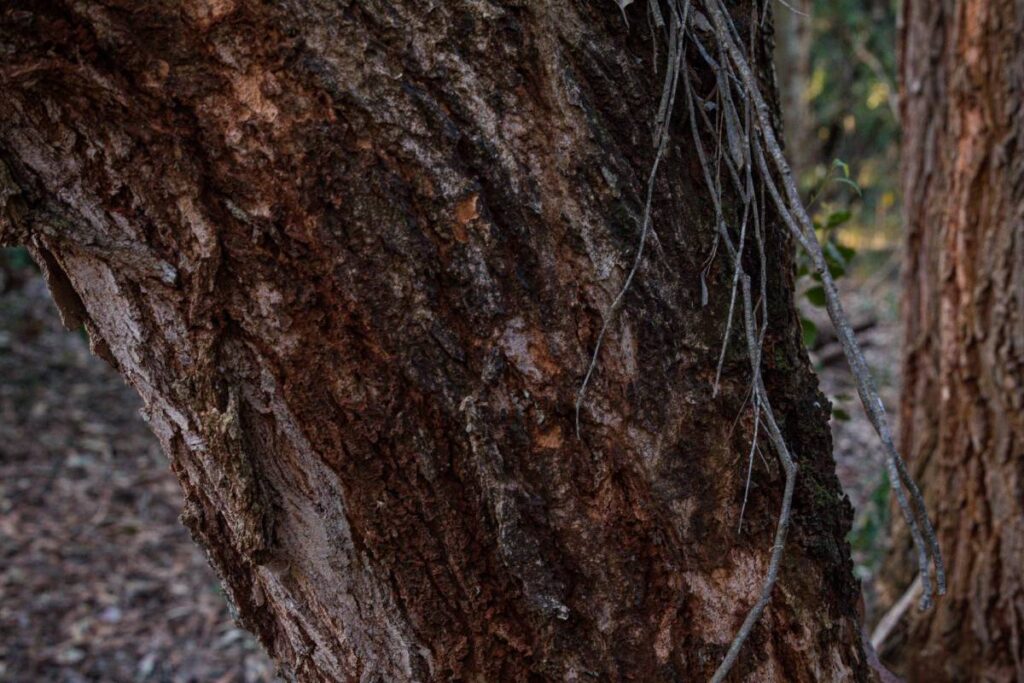
Warning Sign 2: Significant Leaning or Instability
A slight, natural lean is normal for many trees, but a sudden or severe lean (typically 15 degrees or more) is a flashing red light.
- A tree doesn’t fall over cleanly; it typically fails at the point where the trunk meets the roots.
- Look for the ground heaving or cracking around the base of the trunk on the side opposite the lean. This is a tell-tale sign of root failure.
- If the tree has developed a severe lean after a recent storm or ground saturation, the entire anchor system is compromised.
User Psychology Insight: Homeowners often try to justify a severe lean by saying, “It’s always been like that.” We must stress that sudden change or visible root lifting is the true danger.
When is a leaning tree safe?
- When the tree has a root flare that is wide and stable.
- When there is no recent soil disturbance or root upheaval.
- If the lean has been consistent and the tree shows no other signs of distress.
Warning Sign 3: Extensive Internal Decay and Fungal Growth
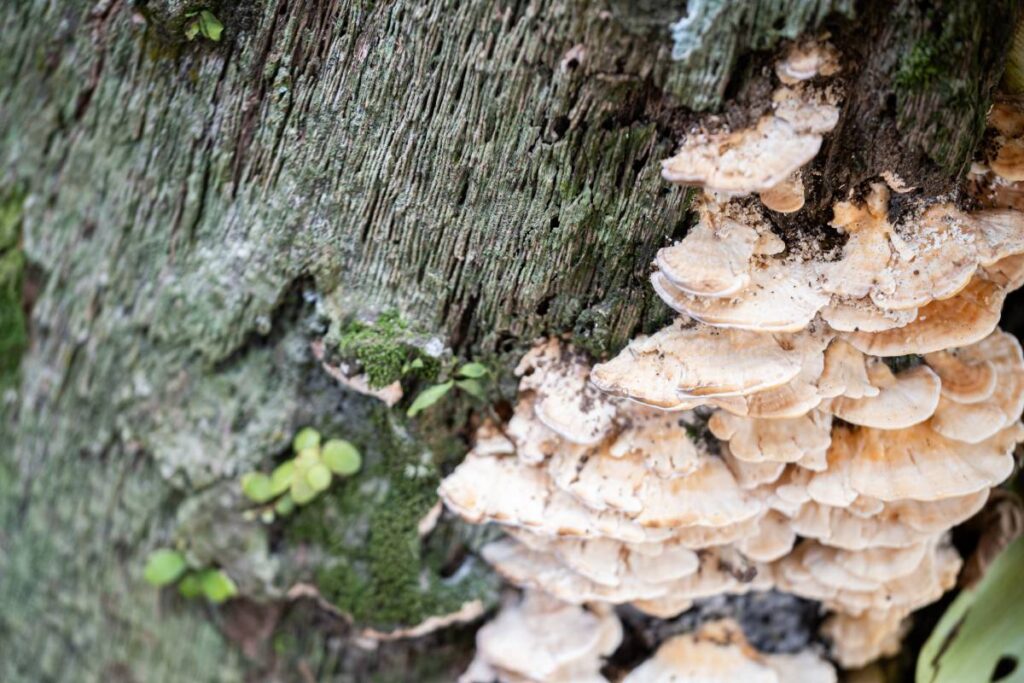
The presence of mushrooms or “conks” growing on the trunk or branches is not merely cosmetic; it is proof of deep, internal decay.
- Conks (shelf fungi) are the fruiting bodies of fungi that are actively consuming the tree’s structural wood. The damage is already done inside.
- Decay weakens the wood cells, turning strong, supportive tissue into soft, crumbly pulp.
- The exterior might look sound, but decay often hollows out the core, leaving only a thin shell of living wood.
Analogy: A tree with conks is like a house with severe termite damage—it looks fine until a critical support beam collapses.
Warning Sign 4: Deadwood and Canopy Loss
Sometimes, what looks like irreversible decay is actually a response to poor soil conditions. Before making a final decision, it is worth investigating what overfertilising and under-fertilising look like, as nutrient imbalances can occasionally mimic signs of decline.
A healthy tree has a dense, vibrant canopy. When the upper limbs and canopy begin to die back, the tree is losing its ability to sustain itself.
- A tree that has more than 50% dead branches is a high-risk candidate for removal.
- Dead limbs can break off without warning, even on calm days, becoming deadly projectiles.
- The tree is struggling to transport water and nutrients to the crown, often due to root rot or severe disease.
Remember: Dead wood is dry wood, and it presents a significant fire hazard, especially in dry climates. Pruning can address minor deadwood, but extensive dieback signals a systemic issue.
Warning Sign 5: Damage to the Root Collar and Base
The root collar is the critical area where the trunk flares out and meets the soil. Damage here is catastrophic because it affects the tree’s life support and its anchor.
- Look for girdling roots (roots growing tightly around the trunk) that choke the tree.
- Check for damage from lawnmowers or string trimmers—these wounds allow insects, disease, and fungi direct entry.
- Piles of mulch piled high against the trunk (a practice known as “mulch volcanos”) cause the bark to rot and invite decay.
Pro-Tip: Gently scrape away excess mulch and soil to inspect the flare. A healthy tree should widen naturally at the base.
Warning Sign 6: Cavities and Hollow Spots
Cavities—holes in the trunk or major limbs—are often signs that internal decay has progressed significantly.
- A small cavity may host wildlife, but a large, deep cavity substantially reduces the wood volume necessary for structural support.
- The most dangerous cavities are those located high up in the tree or on the underside of major branches.
- Arborist Assessment: Only an arborist can use a sounding tool or a resistograph to determine the percentage of sound wood remaining. If the shell is too thin, the tree cannot be saved.
Warning Sign 7: Pest Infestation and Disease
While some pests (like aphids) are nuisances, others are lethal attackers that compromise structural integrity.
- Emerald Ash Borer (EAB): This pest has devastated Ash trees. Look for D-shaped exit holes and S-shaped tunnels under the bark.
- Termites/Carpenter Ants: The presence of these insects often indicates that the wood is already decayed and soft enough for them to tunnel through. They are exploiting the weakness, not necessarily creating it.
- Oak Wilt or Dutch Elm Disease: These vascular diseases can kill a mature tree in a single season. Immediate action is required to save the tree or prevent the spread to neighbors.
Actionable Advice: If you see sawdust-like material (frass) around the base or unusual holes, contact a specialist immediately.
What to Do After You Identify a Problem
If your visual inspection confirms one or more of these critical signs, do not attempt removal yourself. This is where the informational intent shifts decisively toward commercial action.
- Stop Disturbance: Do not prune, cut, or stress the tree further. Keep children and pets away from the fall zone.
- Contact a Certified Arborist: Look for an arborist who is ISA (International Society of Arboriculture) certified. They specialize in risk assessment.
- Request a Risk Assessment: An arborist can provide a documented assessment using specialized tools to measure wood strength and decay.
- Get Quotes: Tree removal is a hazardous job. Ensure the company is licensed, bonded, and carries sufficient insurance—this protects you in the event of an issue.
Caution: The cost of a professional assessment is negligible compared to the cost of property damage, a hospital bill, or a liability lawsuit.
Conclusion: Protect Your Investment
Your trees are a valuable asset, contributing to your property value and quality of life. But when a tree turns dangerous, it transitions from asset to liability. We’ve identified seven critical warning signs: deep cracks, severe lean, decay, deadwood, root damage, cavities, and severe infestation.
Your next step is clear: Don’t guess; assess.
By taking decisive action and consulting an ISA-certified arborist today, you are not just removing a dangerous object—you are actively investing in the safety and longevity of your home.
What is the single biggest sign of tree danger you have noticed in your neighborhood? Share your experience in the comments below!
Frequently Asked Questions (FAQ)
1. How much does professional tree removal cost?
The cost of tree removal varies widely based on size, location, and condition. A small tree might cost $200-$500, while a large, diseased, or difficult-to-access tree near a structure can cost $1,500 to $5,000+. Factors like stump grinding and wood disposal will also affect the final price.
2. Can I save a tree that is leaning severely?
In most cases, a tree that has developed a severe lean due to root upheaval (especially after a storm) cannot be safely corrected or saved. While cabling and bracing can help reinforce certain strong trees, they are not effective solutions for major root failure or severe instability. Removal is usually the safest option.
3. Does insurance cover tree removal?
Generally, homeowner’s insurance does not cover the removal of a healthy tree that has simply fallen. However, coverage often depends on the specific cause of the damage and your policy’s terms. For a detailed breakdown of policy nuances, please refer to our guide on whether tree removal is covered by homeowners’ insurance, which explains the specific perils most insurers typically accept.
4. How long does a dying tree take to fall?
There is no fixed timeline. A tree with a massive internal cavity might stand for years, while a seemingly healthy tree with a compromised root plate could fall during the next heavy storm. This unpredictability is the risk. Once a tree is showing critical signs of failure, its “countdown” has begun, and removal should be scheduled quickly.